Theme Park Manager
- 4.5
- Rating
- 1.00M
- Installs
- Free
- Price

 Analysis by App-foxy
Theme Park Manager is the kind of simulation game I open when I want a small, playful management challenge rather than a deep business spreadsheet. I build a park, work on roller coasters, and try to keep the whole place moving in the right direction. That basic idea is easy to understand, but it also creates a useful question: does the game stay enjoyable when progress becomes slower, or does spending start to feel like the main solution?
After spending time with it, my answer is fairly balanced. The game is approachable, visually easy to read, and well suited to short sessions. It gives the familiar theme-park fantasy a more hands-on feel than simply watching numbers rise. At the same time, anyone expecting a highly detailed management simulator should keep expectations under control. This is a lighter experience, designed to make building and improving a park feel accessible on a phone.
Building a park without turning it into homework
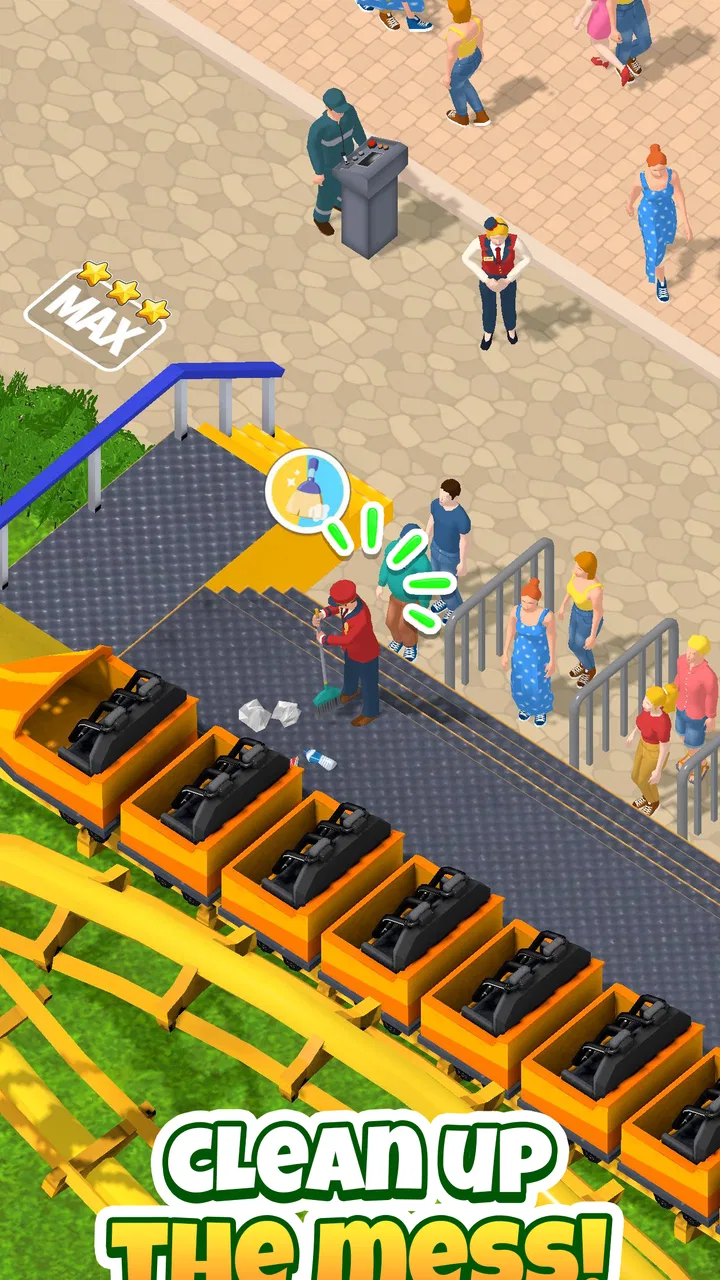
The strongest part of the experience is its immediate theme. You are not managing an abstract factory or a silent collection of menus; you are shaping a place that is supposed to feel exciting. Roller coasters provide the clearest identity, while the wider park-management idea gives the game a reason to keep you checking on improvements. I like that combination because it gives each session a visible purpose: I am not merely increasing a statistic, I am trying to make the park feel more successful.
You May Also Like

 Blood Strike: 2.5 Anniversary
Blood Strike’s Loadouts Turn Every Drop Into a Tactical Gamble
A close look at Blood Strike’s custom loadouts: how fast access to signature weapons reshapes its battle royale rhythm, rewards preparation, and narrows the gap between fights.

 Pandora - Music & Podcasts
Pandora’s Music Is Easy to Start, but Harder to Recover
Pandora’s strength is its low-effort path from a seed to a station. Its weak spot is how much confidence it asks you to place in connection, setup, and quiet recovery.

 8 Ball Pool
 Is Built on Rivalries, Rematches, and Routine
A close look at the rivalries, rematches, shared routines, and unanswered safety questions that turn a quick pool match into a persistent mobile community.

 Samsung Music
’s Quiet Strength Is Playing What You Already Own
Its reach comes less from spectacle than from dependable access to a personal library. That simplicity is both the app’s strongest retention engine and its ceiling.

 AccuWeather: Weather Radar
AccuWeather Review: A Quick, Clear Forecast for Everyday Decisions
For everyday plans, the best forecast is the one you can understand quickly. AccuWeather makes rain timing, radar, and local conditions easy to act on, with a few trade-offs.

 Hill Climb Racing
Why Hill Climb Racing Still Turns Crashes Into One More Run
A tiny car, a bumpy hill and one more upgrade: Hill Climb Racing keeps resurfacing because its simple chaos makes every near-miss feel personal.
More From Our News Desk
View All News


The controls and presentation are aimed at quick understanding. That matters on a mobile device, where a management game can become tiring if every decision is buried under several layers of interface. Here, the appeal comes from making a change, seeing its effect, and deciding what deserves attention next. It is a good fit for a short break, especially when I want something more interactive than an idle game but less demanding than a full strategy title.
One useful way to approach the game is to treat each improvement as part of a priority list rather than spending resources as soon as they appear. I found it more satisfying to pause and ask what will help the park most immediately. A new attraction may be tempting, but improving the part of the park that is already carrying the experience can be a better short-term choice. That habit also makes the game feel less random, because progress comes from decisions instead of constant tapping.
The roller-coaster focus gives the simulation a stronger personality than many general park builders. I enjoy games in this category more when the central theme affects the way I think, and this one at least points my attention toward the thrill-ride side of the park. It is not trying to be a realistic planning tool for someone who wants detailed engineering, staffing, or financial modelling. Instead, it presents the fantasy of running a growing attraction in a compact mobile format.
How the progression feels in ordinary play
A realistic everyday scenario would be opening the game during a commute or while waiting for dinner to cook. I can make a few park decisions, collect the result of earlier work, and close the app without needing to remember a complicated chain of instructions. Later, I can return with a clear idea of what I was working toward. That stop-and-start rhythm suits the game better than marathon sessions, where its simpler systems may begin to feel repetitive.
My main advice is to avoid treating every available improvement as equally urgent. Early excitement can make it easy to spend whatever is available on the most visible option. A calmer approach is more rewarding: first identify the upgrade or construction step that supports the park’s current direction, then save for it. This is a small distinction, but it changes the feeling from button pressing to light planning.
There is also a trade-off between speed and satisfaction. Faster progress can make the park look better sooner, but waiting and choosing carefully gives each milestone more weight. Players who enjoy gradual development may appreciate that rhythm. Players who want a constant stream of major attractions could find the pace less exciting, especially if they dislike revisiting the same management loop while waiting for the next meaningful change.
The game is rated for Everyone, which matches its colorful, uncomplicated presentation. I would still separate age suitability from personal preference. A younger player may enjoy the construction fantasy, while an older simulation fan may want more depth than the format offers. The age rating tells me the tone is broadly accessible; it does not promise the complexity of a traditional PC theme-park management game.
Spending, pressure, and what I would watch
The game is free to download, but it includes in-app purchases ranging from $0.99 to $99.99 per item. That is the most important practical detail for anyone deciding whether to try it. A free entry point is welcome, yet the upper end of the purchase range is substantial, so I would approach the shop carefully rather than assuming every option is minor.
I prefer to begin with a strict rule: play without buying anything and see whether the normal progression feels comfortable. That gives a much clearer impression of the game’s underlying balance than purchasing early convenience. If the park remains enjoyable while I make gradual progress, the free version may be enough. If I feel repeatedly pushed toward the shop, that changes my view, even if the construction itself remains entertaining.
Because the available purchase range covers both a low-cost option and a much larger one, the sensible question is not simply whether purchases exist. The better question is whether spending improves enjoyment or merely removes waiting. I would not spend to solve a frustration I had not yet identified. In a management game, some delay can be part of the intended rhythm; removing all of it may also remove the reason to plan.
I also recommend checking the purchase screen before handing the game to a child. The Everyone rating describes the content, while the presence of paid items creates a separate household concern. A child can find the theme harmless and still misunderstand the real-world value of an in-game purchase. For family use, a device-level purchase safeguard is a sensible precaution.
My fairness judgement is deliberately cautious. The game has a 4.6 average from around 5K ratings, and it has passed 100K installs, so there is clear interest from players. Those figures tell me that many people have found the experience appealing, but they do not by themselves prove that the economy is generous or that paid progress is unnecessary. I would treat the game as potentially enjoyable without spending, while making my own decision after experiencing its normal pace.
Is it fair for players who never pay?
For a single-player-style simulation, competitive fairness is less about defeating other players and more about whether my park feels like my own achievement. If purchases mainly shorten the route to improvements, non-paying players may still have a satisfying experience, provided the waiting does not overwhelm the decisions. If the most interesting parts are consistently locked behind payment, the free version would feel more like a preview.
I could not responsibly call the game pay-to-win because the available facts do not establish a competitive system or explain exactly what each purchase changes. That uncertainty matters. I would not recommend it to someone who needs a clearly documented, purchase-free progression model. I would recommend trying it cautiously to someone comfortable with optional spending, provided they are willing to stop if the pressure becomes irritating.
The best test is personal and practical: play through the opening portion without buying, notice whether the park still gives you meaningful choices, and pay attention to whether you are making decisions or simply waiting. If you can plan, improve, and feel ownership of the result, the model is easier to accept. If every satisfying step seems connected to a payment prompt, the game is probably not the right choice for you.
Where it sits beside other simulation games
Compared with a detailed theme-park management game on a computer, Theme Park Manager is much easier to pick up. You are less likely to spend an evening balancing a large web of operational systems, and more likely to make compact decisions that fit a phone screen. That simplicity is its advantage for casual players, but it is also the reason serious management fans may eventually want something deeper.
Compared with an idle builder, it has a more recognizable fantasy because the park and roller-coaster theme give progress a visual goal. An idle game may be better if you want the numbers to grow with very little input. This game is a better match if you want to feel involved in choosing what to develop, even when the individual decisions remain straightforward.
It also differs from a pure coaster-construction sandbox. A sandbox is usually about designing the ride itself and experimenting freely. Here, the park-management frame gives the construction idea a broader context. I would choose this game when I want the surrounding attraction to matter, not only the shape of one ride. I would choose a dedicated building sandbox when creative control is more important than progression.
That comparison helps define the audience. Theme Park Manager is best for someone who likes the idea of a growing amusement park but does not want a dense simulation manual. It is less suitable for a player looking for realistic economics, detailed guest behaviour, or a large competitive community. The game’s appeal is compact decision-making and theme, not exhaustive modelling.
Version, device fit, and practical expectations
The current version is 9.1.0, and the game requires Android 6.0 or later. That makes it accessible to a broad range of Android devices, although operating-system compatibility alone cannot tell me how smoothly every phone will run it. I would still keep ordinary mobile considerations in mind: screen size, available storage, battery condition, and whether I enjoy touch-based management controls.
It was released on Jun 18, 2025, so I see it as a relatively recent entry rather than a long-established classic. That makes the current version especially relevant when judging the experience, since mobile games can change considerably through updates. I would check the version shown on my device before starting a long-term park, particularly if I care about keeping progress consistent across updates.
The developer is Supercent, Inc., and the game’s store short description is simply “Theme Park.” That concise presentation reflects the straightforward pitch: the attraction itself is the reason to play. I appreciate that clarity. There is no need to learn a complicated premise before deciding whether the concept appeals to me.
Who should try it, and who should skip it
I would recommend it to casual simulation players, theme-park fans, and anyone who likes making visible improvements in short sessions. It is also a reasonable choice for a player who wants a free starting point before deciding whether the style suits them. The combination of a broad age rating, a clear theme, and a manageable mobile format makes it easy to test without committing to a demanding hobby.
I would skip it if my priority is a fully transparent purchase-free economy, because the existence of items priced as high as $99.99 means I would want to inspect the shop and progression personally. I would also skip it if I need deep operational detail or a competitive strategy layer. In those cases, a more complex management game would probably offer better long-term satisfaction.
Another reason to skip it is if I dislike waiting in free-to-play games. Even a well-designed park builder can become frustrating when progress slows, and I do not want to use purchases simply because the game has made patience unpleasant. The right mindset is to see spending as optional and the free route as the real test. If that route does not feel good, buying more is unlikely to fix the underlying mismatch.
My trust verdict after looking beyond the theme
What I like most is the clear loop: develop a park, focus on roller-coaster appeal, and return for another small step. It is friendly, understandable, and easy to fit into normal life. The game does not need a long explanation to communicate its purpose, which is valuable on mobile.
What keeps my recommendation measured is the purchase structure. Free access is a strong reason to try it, but the broad in-app purchase range means I would not describe it as automatically generous. I would play first, avoid impulse buying, and judge the balance by how often the game gives me a meaningful choice without asking me to pay.
My final view is that Theme Park Manager is worth trying for light amusement-park management, especially if I enjoy gradual progress and short sessions. Its 4.6 average and audience of over 100K installs suggest that the concept has connected with plenty of players, but popularity should not replace personal testing. I would recommend it to a friend with one clear condition: enjoy the free park-building loop first, set a spending limit before opening the shop, and move on if the pressure becomes more noticeable than the fun.
For me, the game succeeds when I treat it as a relaxed mobile simulation rather than a definitive theme-park management experience. The fairest way to play is to make the park earn my interest before I let it earn my money. That approach preserves the enjoyable construction fantasy while keeping the financial decision firmly under my control.
FAQs for Theme Park Manager
01What is Theme Park Manager and what can I do with it?
Theme Park Manager is a simulation game that allows you to build and manage your own amusement park. You can design rides, hire staff, set ticket prices, and ensure your visitors have a fantastic experience. The game combines strategic planning with creative design, making it suitable for both casual gamers and those who love management challenges.
02Is Theme Park Manager free to download and play?
Theme Park Manager is free to download on both Android and iOS platforms. However, it offers in-app purchases that allow players to enhance their gameplay experience by unlocking special features, acquiring additional resources, or speeding up progress. These purchases are optional and not necessary to enjoy the game fully.
03What are the system requirements for Theme Park Manager?
To run Theme Park Manager smoothly, your device should have at least 2GB of RAM and a stable internet connection for updates and online features. It is compatible with Android 5.0 and above, and iOS 11.0 or later. Ensure your device has enough storage space, as the game requires regular updates.
04How does Theme Park Manager handle player data and privacy?
Theme Park Manager adheres to strict privacy policies to protect user data. Personal information is used solely for gameplay purposes and is not shared with third parties without consent. Players can review the app’s privacy policy in the settings menu for detailed information on data collection and usage practices.
05Can I play Theme Park Manager offline?
Theme Park Manager requires an internet connection for the initial download, updates, and certain online features like leaderboards and events. However, you can enjoy most of the gameplay offline once these elements are updated. For the best experience, periodic online access is recommended to receive new content and bug fixes.
Pros
- Engaging and intuitive gameplay mechanics.
- Wide variety of rides and attractions.
- Regular updates with new content.
- Social features to connect with friends.
- Visually appealing graphics and animations.
Cons
- In-app purchases can be expensive.
- Requires constant internet connection.
- Advertisements can be intrusive.
- Performance issues on older devices.
- Limited offline play options.

Theme Park Manager
Gallery